
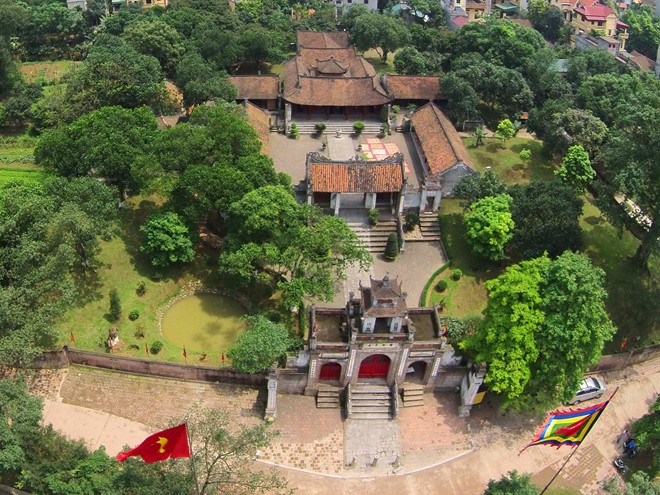
About 16 kilometers north of Hanoi’s Old Quarter lies a fascinating historical gem – Co Loa Citadel. Nestled in the outskirts of Hanoi, in Co Loa Commune, Dong Anh District, this ancient relic holds great significance for both the city of Hanoi and Vietnam as a whole. With its rich legends and unique cultural heritage, Co Loa Citadel stands as a testament to Vietnam’s glorious past.
Unraveling History
Co Loa Citadel proudly claims the title of Vietnam’s oldest building. Dating back to the 3rd century B.C, it served as the capital of the Au Lac Kingdom, established by King An Duong Vuong. Over a thousand years later, under the Dai Viet Kingdom, Co Loa regained its status as the capital. With each passing era, Co Loa Citadel witnessed the continuous development of the Vietnamese people, reflecting their resilience and cultural evolution. The citadel also provides a window into the Dong Son culture, showcasing the Red River civilization of the prehistoric Vietnamese people.
Discovering the Citadel’s Structure
The spiral-shaped Co Loa Citadel, although said to have had nine walls, now reveals only three main walls.
The Outer Wall (Thanh Ngoai): With a circumference of approximately 8 kilometers and an average height of 4-5 meters, this wall was built by digging soil to create moats.
The Middle Wall (Thanh Trung): Resembling the Outer Wall in structure, the Middle Wall boasts a narrower and more solid area, spanning about 6.5 kilometers.
The Central Wall (Thanh Noi): Serving as the residence of the king and select mandarins, the Central Wall features a smaller circumference of around 1.65 kilometers. It is home to the An Duong Vuong Temple, the Temple of My Chau Princess, and other historically significant structures.

Must-Visit Sights within Co Loa Citadel
An Duong Vuong Temple (Thuong Temple)
When exploring Co Loa Citadel, the An Duong Vuong Temple stands out as a must-visit destination. Situated on the ancient hill that once housed the king’s palace, the temple was built in 1687 during the reign of King Le Hi Tong. It offers a glimpse into the remarkable sculpture art of the Le Dynasty. In front of the temple, you’ll find the stone statues of two intricately carved dragons, a symbol of Vietnamese culture. Ngoc well, located nearby, holds a tale from legend – the tragic story of Trong Thuy. Inside the temple, bronze statues of An Duong Vuong, white and pink horses, and various bronze and porcelain artifacts can be admired.
Co Loa Communal House
Built at the end of the 18th century, Co Loa Communal House showcases the focal point of social gatherings and communal observances during the reign of King Thuc Phan. Marvel at the delicately carved and gilded door, which features Vietnam’s four sacred creatures (dragon, unicorn, turtle, and phoenix) and four typical flowers (peach, chrysanthemum, bamboo, and apricot). This architectural masterpiece reveals artifacts of great historical value from thousands of years ago.
Temple of My Chau Princess
Also known as the tomb of Princess My Chau, this temple houses a natural stone known as the “My Chau stone,” shaped like a headless person. Legend has it that after her death, My Chau transformed into this stone, which drifted to Duong Cam on the east side of Co Loa Citadel. The stone was eventually brought back and placed at the stump of a banyan tree, where the temple now stands. You’ll also find a horizontal lacquered board on the temple wall, featuring a poem in Chinese characters by poet Chu Manh Trinh. The temple’s intriguing legend attracts curious visitors from far and wide.
Cao Lo Temple
To commemorate the remarkable general Cao Lo, who invented the Lien Chau crossbow and played a crucial role in constructing Co Loa Citadel, the Cao Lo Temple was built. A statue of Cao Lo wielding a crossbow stands proudly in the middle of the lake in front of the temple. Paying homage to this brilliant military strategist, the temple captivates with its devotion to Vietnam’s history.
The Perfect Time to Visit
For a festive atmosphere and an immersive experience of Vietnamese culture and customs, plan your visit to Co Loa Citadel on the 6th day of the lunar January. This is when the Co Loa festival takes place, featuring processions, liturgies, and unique folk games. However, if you prefer a quieter visit, allowing you to appreciate the magnificent architecture and absorb the stories associated with the citadel, it’s best to avoid festival days and weekends when the crowds are larger.
Getting There
Located on the outskirts of Hanoi, Co Loa Citadel is easily accessible for those eager to delve into Vietnamese culture and history. It sits approximately 15 kilometers from Hanoi’s Old Quarter. To reach the citadel, you can travel by motorbike or car. Follow Highway 1A, cross the Duong River bridge, turn left from Yen Vien Town onto Highway No.3, and ride for another 5 kilometers until you reach Co Loa Citadel. Alternatively, you can opt for a more budget-friendly option by taking the bus. Bus No. 46 from My Dinh area and Bus No. 15 and 17 from Long Bien transit station will transport you to this historical site.
Useful Information
- Location: Co Loa, Dong Anh, Hanoi
- Best for: All visitors
- Entrance: N/A
- Hours: Daytime visits are recommended
- Distance to city center: 10.4km (6.5 mi)
Experience the allure of Co Loa Citadel, a captivating testament to Vietnam’s ancient cultural heritage. Rừng Cúc Phương


